
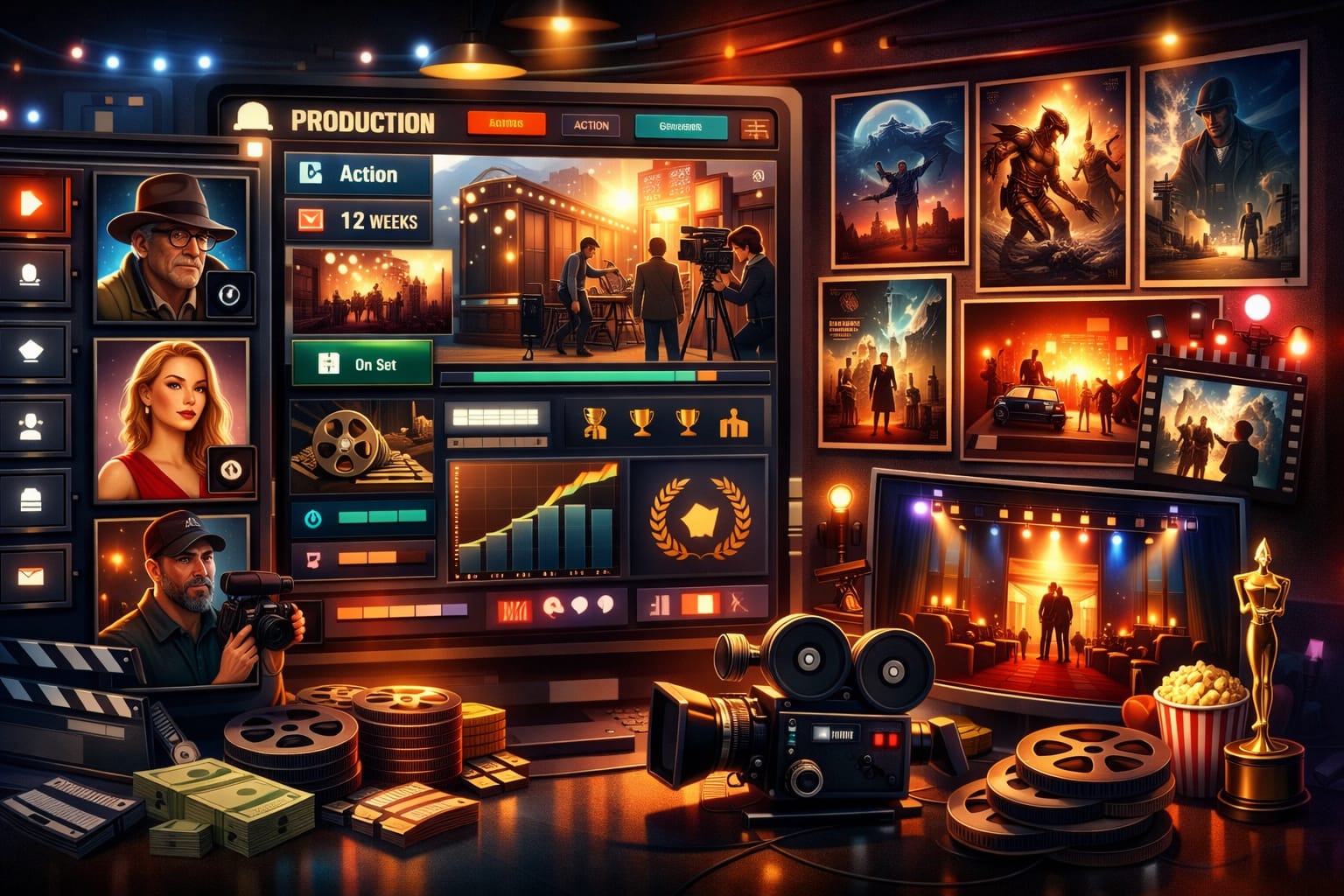
During my New Year break (late December 2025 into early January 2026), I finally shipped a project I have wanted to build since 2009. The game is called SIMEMA, short for simulation plus cinema. SIMEMA lets you run your own movie studio in your browser. You hire talent, choose genres, manage budgets, release films, and watch box office results swing between hits and painful flops.
You can play SIMEMA right now in your browser here: https://simema.gamer.gd/. No install, no account. Open the link, start a new studio, and see how your first film performs.
I feel proud of this release for a simple reason. The scope turned out huge. Even without writing most of the code by hand, the build took close to three weeks because the feature list kept growing, week after week, scene after scene, system after system.
WHERE THE IDEA STARTED, SHANGHAI 2009
Back in 2009, I lived in Shanghai and got hired to produce a video about a game company. Social games ruled the time. Mafia Wars and Farmville pulled people back every day with simple loops, progression, and friendly competition.
While filming and talking to game developers, one idea stuck in my head.
A tycoon game about making movies.
Not a generic “studio manager” menu. A game where you choose your actors, directors, cinematographers, editors, composers, producers, then release films and compare results against other players. A game where creative choices matter, and your studio identity grows over time.
Back then I wrote a PDF concept document and kept the idea on ice. Life moved on. Work moved on. The concept stayed.
FAST FORWARD TO NOW, AI MADE THE BUILD POSSIBLE
During my New Year break, I revisited the old PDF and treated the document like a blueprint. This time, the missing piece was no longer time or motivation, the missing piece was execution speed.
AI pair programming changed the workflow.
My role looked more like product owner and creative director:
- Define a feature clearly
- Let AI draft the implementation
- Test the feature in the browser
- Push back on edge cases and UX
- Repeat until the system feels right
This loop gave me the leverage to build far more than I would have built alone in the same time window.
I also used MidJourney to create images for the game. Those visuals helped a lot. A movie studio game lives and dies by vibe. Artwork makes menus feel like a world, not a spreadsheet.
THE DESIGN GOAL: SIMPLE TECH, DEEP GAME
I wanted a game that loads fast and runs anywhere. No installs. No backend. No account. You open a link and start playing.
To support that goal, the stack stays deliberately straightforward:
- Vanilla JavaScript
- Tailwind CSS via CDN
- Web Audio API for procedural sound effects
- localStorage for save games
- ES6 modules for data separation
A single main JavaScript file grew into an oversized beast (over 11,000 lines), which tells two stories at once. First, the scope became real. Second, refactoring into modules sits high on the roadmap.
THE CORE LOOP: A WEEK-BY-WEEK STUDIO SIM
SIMEMA runs on a weekly simulation loop. Each week moves productions forward and updates your studio state:
- Productions progress toward completion
- Released films generate income, then decay over time
- Random industry events shift the market
- You decide what to produce next, when to release, and how hard to expand
The loop stays simple, but the choices stack up. One bold decision early can set you up for a breakout run or a slow bankruptcy spiral.
MAKING A FILM, THE HEART OF SIMEMA
The main action in SIMEMA is film production. A new project asks you to commit to real trade-offs:
- Genre selection (fourteen genres, Action through Western)
- Budget tier (Micro through Blockbuster)
- MPAA rating (G through NC-17)
- Runtime (ninety, one hundred twenty, one hundred eighty minutes)
- Crew hiring: writer, director, lead actors, cinematographer, editor, composer, producer
- Filming location, from backlot to far-away locations
Every choice affects performance. A mismatch between genre and rating hurts. A great runtime fit helps. A strong crew match boosts results.
THE LEARNING SYSTEM: YOU EARN KNOWLEDGE THROUGH PLAY
One mechanic I love is the learning system.
At the start, the game does not hand you a perfect build guide. You learn what works by producing films and reading outcomes. After a release, SIMEMA shows what worked well and what did not. Over time, your studio gains practical knowledge about:
- Best rating per genre
- Best runtime per genre
- Crew specializations by genre
- Best cast size patterns per genre
The result: early films feel like experiments, and later films feel like mastery.
ENSEMBLE CASTING, MORE STARS IS NOT ALWAYS BETTER
Bigger budgets open ensemble casting. Blockbusters support more lead and support actors. Lower budgets keep casts tight. The catch: genre matters.
Some genres thrive with one strong lead. Some genres benefit from a duo. Some genres reward a full ensemble. The game pushes you to think like a producer, not like a collector of famous names.
MONEY PRESSURE: LOANS, INTEREST, AND BANKRUPTCY
A studio game needs risk. SIMEMA includes a bank system with multiple loan tiers and interest rates. Loans save a run when cash goes low, but loans also trap reckless studios.
Miss payments repeatedly and bankruptcy ends the run. A blockbuster funded by debt becomes a real gamble, not a free upgrade button.
TALENT CAREERS: FAME RISES AND FALLS
Actors gain fame when films perform well. Fame pushes fees upward. Fame also fades over time without work.
A cheap unknown actor early on can turn into an expensive star later. Managing talent becomes a long game: short-term savings versus long-term value.
FESTIVALS, AWARDS, AND PRESTIGE
SIMEMA also includes a festival layer. You submit your strongest work to major festivals and chase wins that raise studio reputation.
Festival success gives a second path to growth. Not every studio run needs to chase box office only.
ACHIEVEMENTS AND CHALLENGES
SIMEMA tracks a lot. Over seventy achievements reward milestones and odd goals:
- First film finished
- First hit
- Genre milestones
- Budget tier goals
- Festival wins
- Hidden secrets
Achievements help pacing. You always have a next target, even during a rough financial patch.
INDUSTRY EVENTS THAT SHAKE THE PLAN
Random industry events push the market around. A strong run needs adaptation, not autopilot. Some weeks support theatrical releases, some weeks push you toward safer choices.
WHY I WANTED THIS GAME TO EXIST
SIMEMA started as a notebook fantasy in Shanghai, shaped by the social game era and my love for film production roles. The concept sat for years because the build felt too big for one person.
AI pair programming changed the equation. With the old PDF as a guide, I could focus on design decisions, pacing, balance, and UI clarity, while AI handled a lot of implementation work. The result is a real, playable game, built fast, but still shaped by a long-held idea.
WHAT COMES NEXT
A few improvements already sit on my list:
- Split the big JavaScript file into cleaner modules
- Add more crew variety and deeper role traits
- Expand festival systems and long-term studio growth
- Add more UI polish and more content variety
I want to keep SIMEMA fun first, and deeper second. A studio sim should stay readable even when the systems get rich.
THANK YOU FOR PLAYING
Here’s the link again: https://simema.gamer.gd/. I’d love to see what kind of studio you build, and which genres and crew combos you discover first.
I hope you enjoy SIMEMA and have fun building your studio, taking risks, and chasing both hits and prestige. If you spot bugs, balance issues, or missing features, send me feedback by email using the contact address on this site. I read everything, and I will try to improve the game based on your notes.